


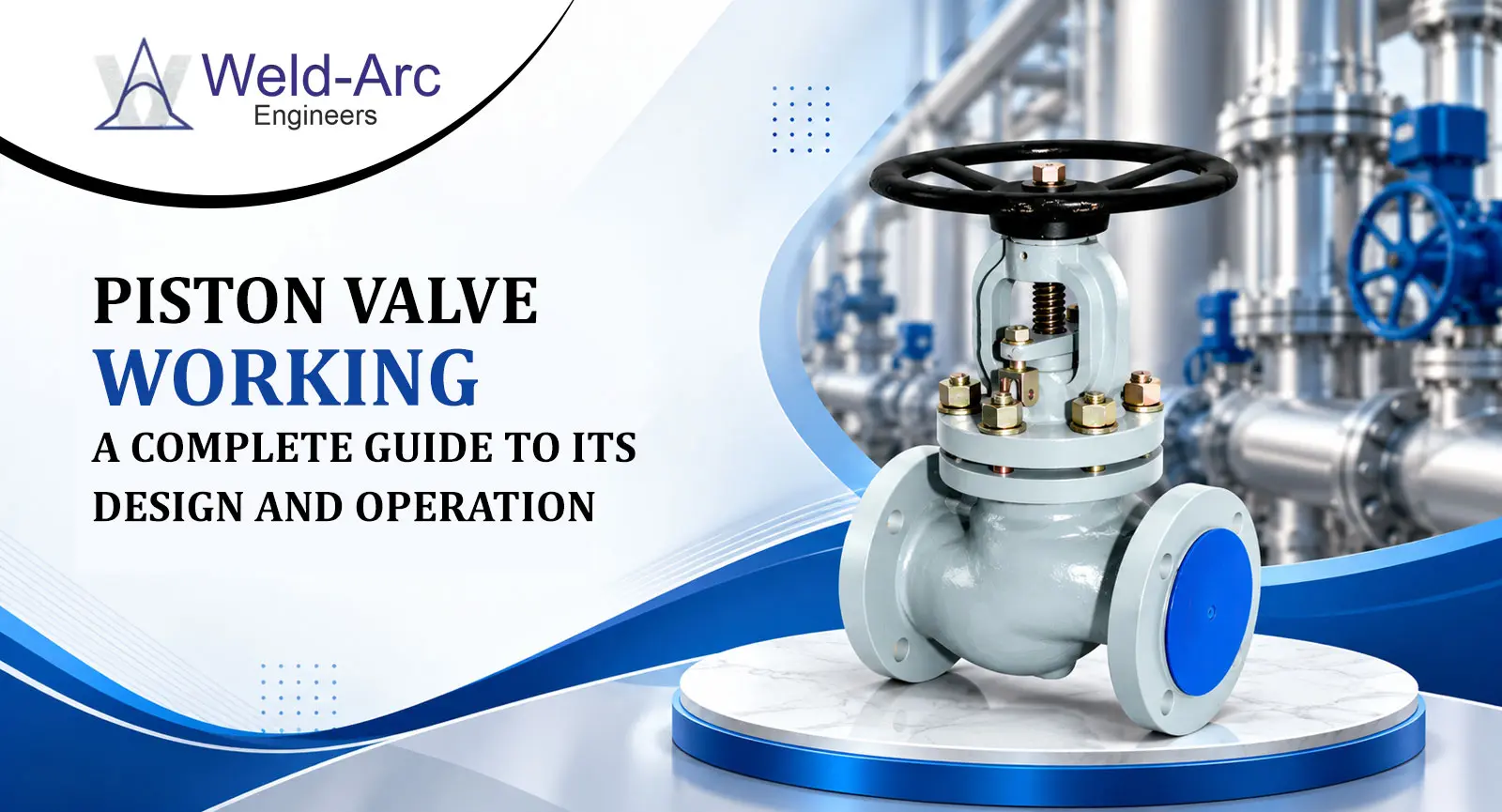
Quick Summary: A piston valve shuts off flow by moving a metal piston up and down inside a cylindrical body, sealed tight by a set of hardened valve rings. This article is all about how a piston valve is built, what happens inside it when you turn the handwheel, how it stacks up against a globe valve, and what to think about before specifying one for a steam or high-temperature line.
Table of Contents
Introduction
Inside a piston valve, shutting off flow comes down to one simple motion: a piston sliding straight up or down inside a cylinder, sealing the passage the moment it reaches the bottom. That’s the entire working principle of this valve, but the way that motion gets executed is what makes this valve stand apart from gate valves, globe valves, or anything using a rotating disc. As the piston travels, PTFE sealing rings press tightly against the cylinder wall, creating a shutoff tight enough to hold against steam pressure or aggressive process media without leaking over time. And because only the very tip of the piston ever touches the flowing fluid when the valve is fully open, the sealing rings themselves stay shielded from erosion the entire time the valve is in use. That single design choice, protecting the seal from the media it’s controlling, is what this article unpacks in full: how the piston moves, what’s built around it to make that motion reliable, and why that reliability holds up in conditions that wear other valves down fast.Working Principle of a Piston Valve
It helps to actually know what’s happening inside the body the moment someone turns that handwheel. Here’s how the motion plays out, step by step:- Someone turns the handwheel, and that rotation gets converted into a threaded stem’s straight-line travel. The handwheel itself never touches the flow path directly; it’s just driving the stem, which does the pushing.
- The piston rides down that stem and presses into the valve rings. This is the point where flow stops completely, and it happens because the rings are machined to a tight tolerance around the piston, not because anything jams or wedges into place.
- Lift the piston back up, and the flow path opens again. Fluid or steam moves through with surprisingly little turbulence compared to a valve that relies on a disc swinging out of the way.
- The rings, not the piston metal, are doing the sealing work. Think of piston rings in a car engine, sliding against the cylinder wall and adjusting for tiny amounts of wear rather than leaking the second a surface loses its perfect finish. Piston valve rings work on more or less the same idea.
- There’s often a built-in relief path for trapped pressure too. If pressure builds up somewhere it shouldn’t, usually because of thermal expansion in a section of pipe that’s closed off, a lot of these valve designs let that pressure bleed back safely instead of straining the body or the line around it.
Key Components That Make Up a Piston Valve
Strip this valve down to its basics, and you’ll find a fairly small set of parts, but each one is doing something specific to keep the seal working:- The piston. A precision-machined metal cylinder that slides inside the bore, opening and closing the flow path as it moves.
- Valve rings, typically a pair of them, which form the sealing surface and carry most of the credit for why these valves are so leak-resistant.
- The lantern bush, a metal sleeve that keeps the piston aligned and guided as it travels up and down inside the body.
- The stem and bonnet assembly, which carries motion from the handwheel or actuator down to the piston while keeping pressure from escaping out the top of the valve.
Balanced vs Unbalanced Piston Valves
Not all valves are built the same way on the inside, and this is one of those distinctions that trips people up more often than it should. The differences between these valves are:- Balanced piston valves have pressure acting on both sides of the piston, which means less force is needed to open or close the valve even when line pressure is high. This is why they’re the go-to choice for high-pressure steam and process work, where an unbalanced design would need a lot more muscle to operate.
- Unbalanced piston valves only have pressure acting on one face of the piston. The design is simpler and usually cheaper, but that only works out fine on lower-pressure systems.
- Regulating-type pistons have a tapered bottom half, which creates a throttling effect for applications where you need to modulate flow rather than just switch it on or off.
Choosing the Right Industrial Piston Valve for Your Application
Picking the right industrial valve isn’t about grabbing the closest size. It’s about matching the build to what your system will actually throw at it. The following are the things to consider while selecting the valve:- Line pressure and temperature. Work out whether you need a balanced or unbalanced design based on your system’s pressure class, not just the pipe diameter you’re working with.
- Media type. Saturated steam, superheated steam, and hot water each stress the valve rings and lantern bush material in slightly different ways.
- Cycle frequency. A valve that’s isolated once a month wears very differently than one that’s cycled several times a shift.
- Standard compliance. Most piston valves are built to ANSI, ASME, or DIN dimensional standards, so it’s worth double-checking that face-to-face and flange dimensions line up with your existing pipeline valves before you order.
- Size range. These valves are generally available from half an inch up to eight inches, spanning ANSI class 150 through 800, so match the class rating to your actual system pressure rather than rounding up out of caution.
Conclusion
A piston valve has one task: sealing off flow completely and holding that seal, cycle after cycle, in conditions that wear weaker designs down fast. Whether a valve lasts for years or needs early replacement almost always comes down to one thing: getting the sealing ring material right from the start, not just the pressure rating. Weld Arc Engineering builds its valves around exactly that kind of long-term reliability, not just something that looks good on paper.FAQs
What is the function of a piston valve?
Its work is to open or completely shut off flow through a pipe, using a piston that slides up and down inside a cylinder instead of a gate or a rotating disc. When closed, sealing rings around the piston press against the cylinder wall to stop flow entirely, and because most of the piston stays out of the flow path while open, that seal holds up even with steam or abrasive media running through it.
Can a piston valve be used for throttling or only for on-off control?
Standard valves are built mainly for isolation, but regulating-type versions with a tapered piston base are made specifically for throttling duty.
How long do the valve rings in a piston valve typically last?
It depends a lot on how often the valve cycles and how hot the media runs, but the sliding ring design generally outlasts a comparable globe valve seat because it can wear gradually without leaking right away.
What sizes do industrial piston valves usually come in?
Most are available from half an inch to eight inches, covering ANSI class 150, 300, and 800 pressure ratings.
Is a piston valve suitable for cold water systems or only steam?
Piston valves are best known for steam and hot water service, but the same tight-shutoff design holds up well in other high-pressure fluid isolation work too.

Weld-Arc Engineers
Weld‑Arc Engineers is a trusted supplier and distributor of industrial products for sectors like oil & gas, pharmaceuticals, water treatment, and more. The company offers a wide range of solutions, including valves, gaskets, pumps, and welding equipment from leading brands like Crane Saunders and ESAB, with a strong focus on quality and customer service.