


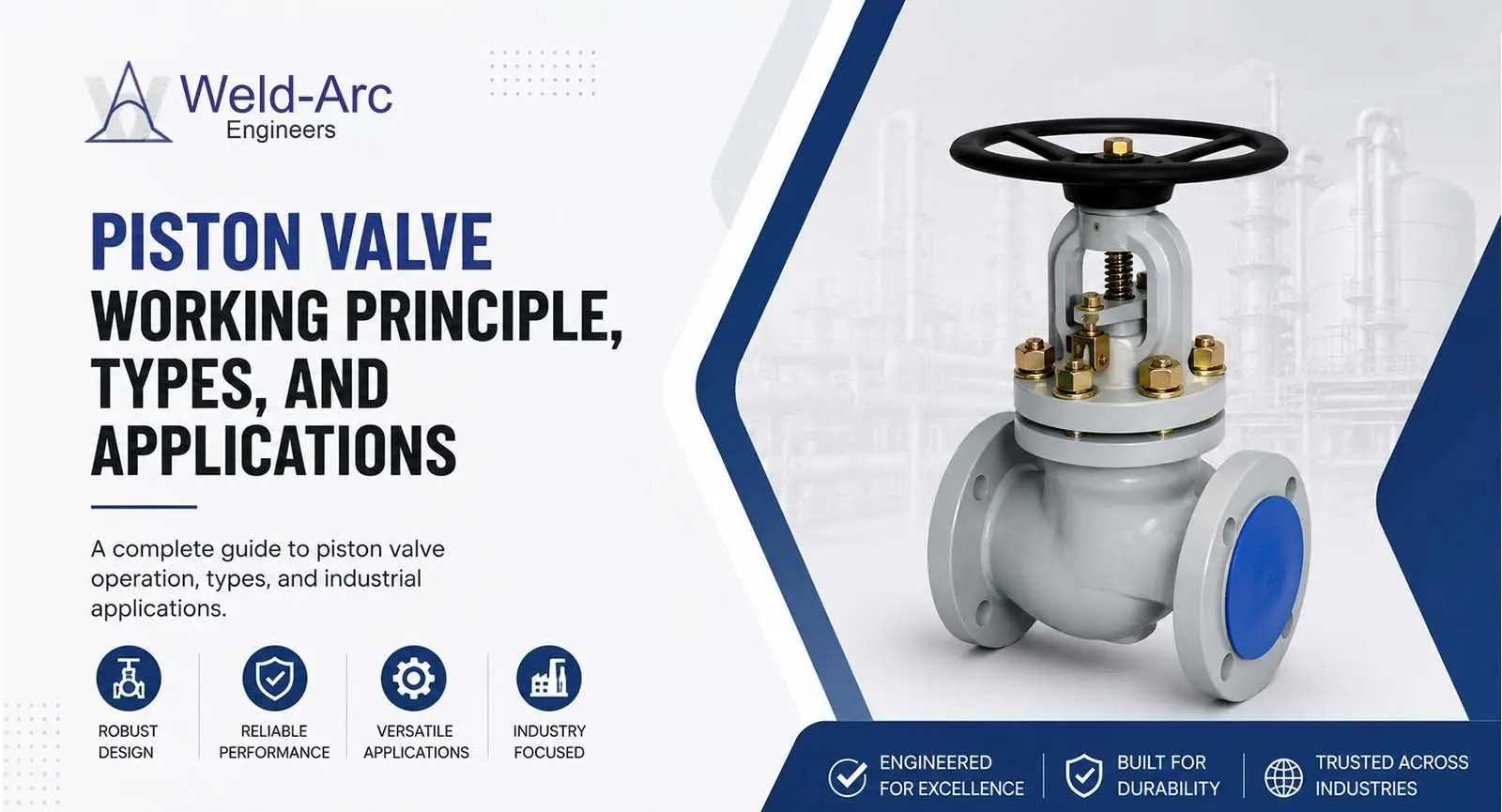
Every plant has valves. Dozens of them, sometimes hundreds. Gate valves, globe valves, ball valves, and check valves. They are placed on pipelines, get opened and closed thousands of times, and most people do not think twice about them until one starts causing problems. The type of valve matters more than most people realise until they are dealing with a leak, a seized seat, or a maintenance job that should have been simple.
The piston valve is not complicated. It works on a straightforward principle, needs very little maintenance, and handles some of the hardest conditions in industrial piping without complaint. Engineers who know it well tend to specify it again and again. The ones who have not come across it yet are usually surprised by how capable it is.
What Is a Piston Valve?
When the piston moves down, it closes off the flow path inside the valve body. Fluid stops. When it moves back up, the path opens again, and fluid passes through. The whole control mechanism is one cylindrical component moving in two directions.
Standard gate and globe valves rely on metal-to-metal seating. That wears over time. Piston valves work differently. Resilient sealing rings create the seal instead. The piston moves vertically between them. No metal grinding on metal. No seat erosion. The rings take the wear, so the valve body does not have to.
The result is a bubble-tight shutoff that meets Class VI leak standards. That is the highest level of tightness you can get in a valve.
Working Principle of a Piston Valve?
Here is how it works in plain terms. The valve body has a flow path running through it. Sitting across that path is a stainless steel piston. Around the piston are sealing rings, which are the heart of the valve.
When you turn the handwheel or activate the actuator, the spindle pushes the piston downward. The piston presses against the sealing rings and cuts off the flow completely. Open the valve again, and the piston lifts, the rings release, and fluid moves through freely.
Because the piston never rubs against a metal seat, the sealing surface stays intact for a very long time. The rings take all the wear instead, and they can be replaced without replacing the whole valve. That is what makes servicing it so straightforward.
One more thing worth knowing. This design is both seatless and glandless. No gland means no packing to leak and no gland maintenance. That alone makes it stand out from conventional valve types.
Types of Piston Valves
Not all of them are built the same way. There are several configurations designed for different situations.
Standard Piston Valve
The standard version for general industrial use. Handles steam, water, gases, acids, heat transfer oils, and many other media. Available in forged carbon steel and stainless steel from 15 mm to 40 mm in screwed and socket-weld ends. Larger sizes from 50 mm to 200 mm are available in cast carbon steel and stainless steel with flanged ends to 150#, 300#, and DIN standards.
Regulating Piston Valve with Lantern Bush
This version is designed for throttling. When you need to partially open a valve and hold it at a specific flow rate rather than just fully open or closed, the regulating configuration handles that job. The lantern bush allows coarse flow regulation without damaging the sealing rings.
Extended Spindle Piston Valve
Built for two specific situations. First, cryogenic applications where the valve handles extremely cold media, and you need the handwheel positioned away from the cold zone. Second, hot media applications where the extended spindle keeps the heat away from the operator’s hands and prevents heat transfer to the handwheel.
Jacketed Piston Valve
Some fluids solidify or crystallise when they cool down. Bitumen, certain chemicals, and some process fluids are examples. This version has a heating jacket around the valve body. Steam or thermal oil circulates through the jacket to keep the media at the right temperature so it stays fluid, and the valve keeps working.
Actuated Piston Valve
For remote operation. It can be fitted with a pneumatic, hydraulic, or electrical actuator. Instead of someone turning a handwheel manually, the valve opens and closes on a signal. Used in a
Where Piston Valves Are Used
The sealing rings are available in non-asbestos, tanged graphite, and graphited asbestos varieties. That range of ring materials is what allows the valve to handle over 250 different industrial media.
- Steam systems are one of the most common applications. They handle steam cleanly, with no leakage to the atmosphere and no seat damage from repeated operation.
- Heat transfer oil circuits run at high temperatures and cannot tolerate leaking valves. The glandless design is ideal here because there is no packing to degrade under heat.
- Acids and corrosive chemicals are handled well with the right ring and body material combination. The sealing system does not expose metal surfaces to the process fluid the way a conventional valve does.
- Vacuum applications need valves that hold tight in both directions. This design does it reliably.
- Hazardous gases require zero leakage to the atmosphere. The glandless, bubble-tight design makes it a trusted choice where gas leaks are not an option.
Why Engineers Prefer Them in Tough Conditions?
A few reasons come up consistently.
- No seat erosion. The sealing rings take the wear, not the body of the valve. The valve keeps performing well long after a conventional seat would have worn down.
- No gland leakage. Because there is no gland, there is nothing to leak to the outside. For hazardous or valuable media, that matters a great deal.
- Easy maintenance. When the sealing rings eventually wear out, they are replaced without removing the valve from the pipeline. Fast, simple, and cost-effective.
- Energy saving. One that does not leak does not waste the media inside it. For steam systems, especially, even a small leak adds up to significant energy loss over time.
Conclusion
Simple in concept. Tough in practice. It handles the process that other valves struggle with, stays leak-free for longer, and costs less to maintain over its working life.
Every application has the right answer when it comes to valve selection. Weld-Arc Engineers supplies UKL valves across industrial sectors in India and works through the application requirements before recommending a configuration. Get in touch and start
Frequently Asked Questions
Q: Can a piston valve replace a gate valve or globe valve on an existing line?
A. Yes, that is exactly what it is designed to do. It replaces both gate and globe valves with clear advantages over both. Same pipeline connection, better sealing, no seat erosion, and glandless construction.
Q: How often do the sealing rings need to be replaced?
A. It depends on the media, the operating pressure and temperature, and how frequently the valve is operated. The rings are designed for long service life. When they do need replacement, it is a straightforward job that does not require removing the valve from the line.
Q: Is the piston valve suitable for high-pressure applications?
A. Yes. Forged versions are rated to 800# and are available from 15mm to 40mm. Cast versions with flanged ends go up to 150#, 300#, and DIN standards in sizes up to 200mm. The right specification depends on the pressure class and size required for the application.
Q: What materials are the valve bodies available in?
A. Forged carbon steel, forged stainless steel, cast carbon steel, and cast stainless steel. The choice depends on the media being handled, the operating temperature, and the pressure rating needed.
Q: Can piston valves be automated?
A. Yes. Pneumatic, hydraulic, and electrical actuators can all be fitted for remote or automated operation. This makes them suitable for use in control systems, hazardous areas, and processes where manual operation is not practical.

Weld-Arc Engineers
Weld‑Arc Engineers is a trusted supplier and distributor of industrial products for sectors like oil & gas, pharmaceuticals, water treatment, and more. The company offers a wide range of solutions, including valves, gaskets, pumps, and welding equipment from leading brands like Crane Saunders and ESAB, with a strong focus on quality and customer service.